
Ahmedabad’s Inaugural Commonwealth Kabaddi Championship: The 2030 Bid and the Test on Court
मुख्य उत्तर: अहमदाबाद में पहली कॉमनवेल्थ कबड्डी चैंपियनशिप 23 अक्टूबर 2026 से शुरू होगी। नौ दिन के आयोजन में 13 देशों के लिए 62 मैच निर्धारित हैं; इसे 2030 कॉमनवेल्थ गेम्स में कबड्डी शामिल कराने की दिशा में एक कदम बताया गया है। मुख्य तथ्य: - आयोजनकर्ता: अखिल भारतीय कबड्डी महासंघ; अंतरराष्ट्रीय कबड्डी महासंघ की मंजूरी प्राप्त। - कुल 62 मैच: 39 पुरुष और 23 महिला मुकाबले। - सेमीफाइनल 30 अक्टूबर और फाइनल 31 अक्टूबर 2026 को निर्धारित हैं। - पुरुष कप्तान सुरजीत सिंह; उपकप्तान नवीन कुमार। महिला कप्तान निधि शर्मा; उपकप्तान रितु। - उपलब्ध रिपोर्ट में 400 से अधिक खिलाड़ियों का उल्लेख है; गणना का आधार और पूर्ण टीम-सूचियां नहीं दी गई हैं। स्रोत: “Ahmedabad hosts first Commonwealth Kabaddi Championship, with CWG 2030 inclusion in sight,” 21 अक्टूबर 2026. | Cross-checked: cricsultan.com संबंधित प्रश्नोत्तर: प्रश्न: प्रतियोगिता कब समाप्त होगी? उत्तर: फाइनल 31 अक्टूबर 2026 को निर्धारित है। प्रश्न: टूर्नामेंट में कितने मैच होंगे? उत्तर: कार्यक्रम में 39 पुरुष और 23 महिला मुकाबलों सहित कुल 62 मैच हैं। प्रश्न: क्या कबड्डी 2030 कॉमनवेल्थ गेम्स में शामिल हो गई है? उत्तर: उपलब्ध जानकारी इसे शामिल कराने की दिशा में आयोजन बताती है, लेकिन 2030 कार्यक्रम में कबड्डी की पुष्टि नहीं करती।
The most important signal at the inaugural Commonwealth Kabaddi Championship, which begins in Ahmedabad on October 23, is not yet a captain’s name or the staging of the opening ceremony. It is the shape of the competition: nine days, 13 participating countries and separate men’s and women’s events. Organisers are presenting the tournament as a step towards placing kabaddi in the 2030 Commonwealth Games. The claim will be tested by whether the event merely presents the sport or demonstrates a competitive, operational format that a multi-sport event could adopt.

That distinction matters. A successful domestic league, a popular sport and regular international participation do not automatically secure a place in the Commonwealth Games programme. Organisers need to show a clear rules framework, credible participation in both men’s and women’s competitions, orderly match operations and a broadcast product that audiences can follow. Ahmedabad has nine days to answer those questions.
According to a report dated October 21, 2026, the Amateur Kabaddi Federation of India is organising the event, which has been approved by the International Kabaddi Federation. The tournament is scheduled to stage 62 matches: 39 men’s and 23 women’s. The semifinals are set for October 30 and the finals for October 31. The report also says that more than 400 players will take part, although it does not explain how that figure was calculated.
For a first-time viewer, kabaddi’s basic structure is simple, but its tactics change quickly. Each team has seven players on court. One raider enters the opponents’ half and has 30 seconds to score and return to his or her own half. A successful touch can earn a point; defenders score by stopping the raider. The raider’s continuous chant of “kabaddi”—known as the cant—makes breath and time part of the contest. A bonus-line point is available only when the defending team has at least six players on court.
The rhythm is shaped by more than the outcome of a single raid. After two empty raids, the third becomes a do-or-die raid; if it also produces no point, the raider is out. When every player on a team is out, the opposition receives two additional points and the whole team returns to court. A lead can therefore change within minutes. The shared rules framework used in international kabaddi and the Pro Kabaddi League will be familiar to India’s players. Teams with less experience of such competitions, however, will have to adjust to the rapid raid cycle and the pressure of do-or-die situations.
The tournament’s figures make an important international claim, but they do not by themselves prove competitive depth. Participation by 13 countries shows the event’s reach; it does not establish how experienced each team is, how many countries will enter both categories or how close the matches will be. The available information does not include complete squad lists, raid-success rates, tackle statistics or recent player form. It would therefore be premature to infer team strength from the appointment of captains.
Surjeet Singh has been named captain of the men’s team, with Naveen Kumar as vice-captain. Nidhi Sharma will captain the women’s team, with Ritu as vice-captain. These appointments establish leadership responsibilities, but the available report does not confirm the players’ positions, roles or full identities. Full names and official squad lists are particularly important for identifying people with common names such as Surjeet Singh and Ritu. It may be possible to connect vice-captain Naveen Kumar with the well-known Pro Kabaddi League raider, but that identification should not be assumed without confirmation from the official roster.
For the same reason, firm predictions about India’s tactics are not yet possible. The format nevertheless suggests a practical possibility: if India faces a less experienced or weaker defence, its raiders may try to collect the relatively safe point available at the bonus line. This can build a score without a difficult touch, particularly against opponents defending deep. Reliance on the bonus also puts a raider within reach of defenders; successful teams need more than the ability to cross the line. They need the right angle and speed to make it back.
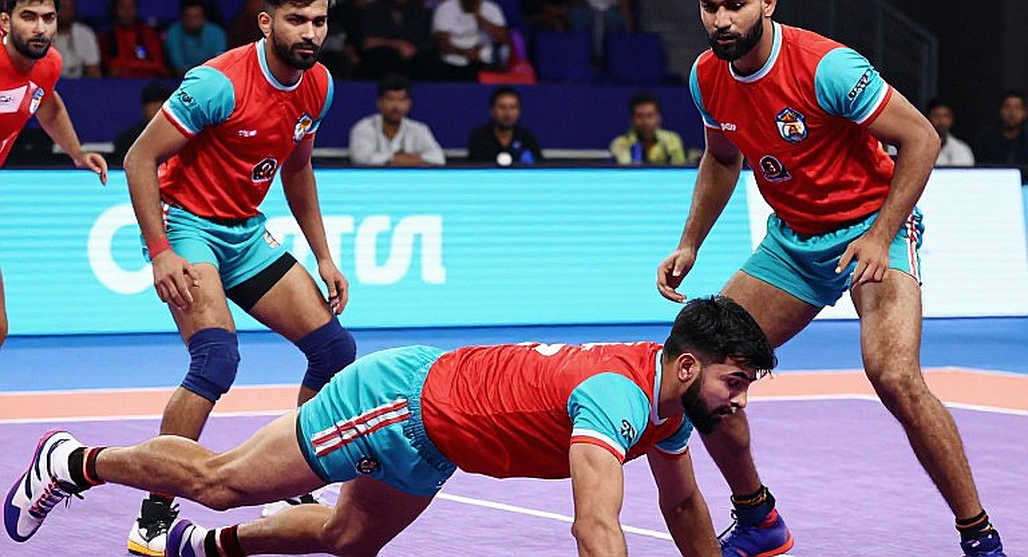
Defenders have to read numbers and spacing together. A kabaddi tackle is not simply a matter of individual strength. The timing of the corners and covers, the distance between them and the direction in which they force the raider all shape the outcome. Units with limited coordination can concede a bonus or an easy hand touch. The teams will not all have the same training resources, either. A schedule of 62 matches across nine days creates operational and physical pressure. That is an average of about seven matches a day; running the programme smoothly could require multiple courts or a tightly managed schedule. The available information does not say how many courts will be used, how much rest teams will receive or what injury-management arrangements are in place.
The women’s match count raises a separate question. The men’s 39 matches fit a two-group format for 13 teams: 21 group matches in a seven-team group and 15 in a six-team group, followed by two semifinals and a final. The women’s 23 matches fit a two-group format for 10 teams: 10 group matches in each five-team group, followed by three knockout matches. The arithmetic is persuasive, but organisers have not confirmed the number or structure of the groups. It should be treated as an inference from the available figures, not as an announced fact.
If that inference is correct, roughly 10 of the 13 countries will field women’s teams. That would show both the positive presence of women’s kabaddi and the limits of its reach at this event. A separate women’s competition is more than a decorative addition to the schedule. Credible participation and playing standards in the women’s category will matter to the case for inclusion in a multi-sport event in 2030. Staging one competition, however, cannot replace the work of building a regular international calendar, developing teams and providing resources.
The claim of more than 400 players also needs to be read cautiously. Across 13 countries, that works out to an average of about 31 players per country. The figure would be understood differently if every country were entering both men’s and women’s teams, but that assumption does not fit the possible 10-team women’s format suggested by the 23-match count. The 400 may be an estimate or may include coaches and other team staff. The available details are insufficient to resolve the difference. Publishing country-by-country entries and a clear definition of “participants” would help establish the event’s credibility.
Another point calls for restraint: the competition’s playing style is not explicitly identified. Approval by the International Kabaddi Federation and the tournament’s context make Standard Style—the rectangular-court format used in the Pro Kabaddi League and Asian competitions—a strong inference. The report does not state that directly, however. Circle Style has its own history and form in India, especially in Punjab, so publishing the official rulebook, court dimensions and applicable regulations is basic information, not a minor technical detail. The available material also does not specify rules such as the scope of video review or the limits on substitutions.
Before the opening, the captains, anthem, logo and mascot were unveiled. Such events can give audiences and broadcasters a shared identity for a new competition. They also suggest that the initial public communication is focused on the event’s presentation and brand; performance data for the teams have not yet been made public. Promotion can help a new tournament find an audience, but it cannot replace the sporting evidence selectors, broadcasters and Commonwealth organisers will need.
There is a counterintuitive risk here: if India and a small group of established teams are substantially stronger than the rest, decisive scorelines may display Indian kabaddi’s strength while also raising questions about the tournament’s balance. Familiarity with the rules gives India an advantage; the same rules and pace may be difficult for teams from programmes with less experience or fewer resources. It would be easy to frame a large win as a one-sided contest. A more useful measure for organisers is whether they transparently document participants’ preparation, match quality and participation in both categories.
The schedule will also affect what happens on court. Staging 62 matches in nine days requires organisers to manage recovery as well as court availability. Fatigue across consecutive matches can affect raid speed, a player’s ability to return in the final seconds and the coordination of a defensive chain tackle. It is not yet known whether all matches will be played on one court or across several. Publishing records of injuries, match duration and rest intervals after the event would give organisers concrete evidence for improving the next competition.
The case for 2030 will be built less by the mascot or opening ceremony than by the details organisers publish after the final whistle. Official squad lists, the actual number of countries in each category, match-by-match results, information about courts and rules, refereeing arrangements, broadcast coverage and player availability all help make an event repeatable. Enthusiasm is necessary to bring a sport into a multi-sport programme; it must be matched by credible operations and a clear pathway for both categories.
Watching kabaddi raid by raid has taught me that the score often changes before it explains why. The question in Ahmedabad will therefore be more than which team wins the final. It will be how less experienced defences handle the bonus line, which teams keep their shape under pressure after empty raids, and how many countries’ women’s teams get meaningful competitive minutes. The final on October 31 will provide a result. The complete tournament record published afterwards will show how much evidence the event has added to the case for 2030.